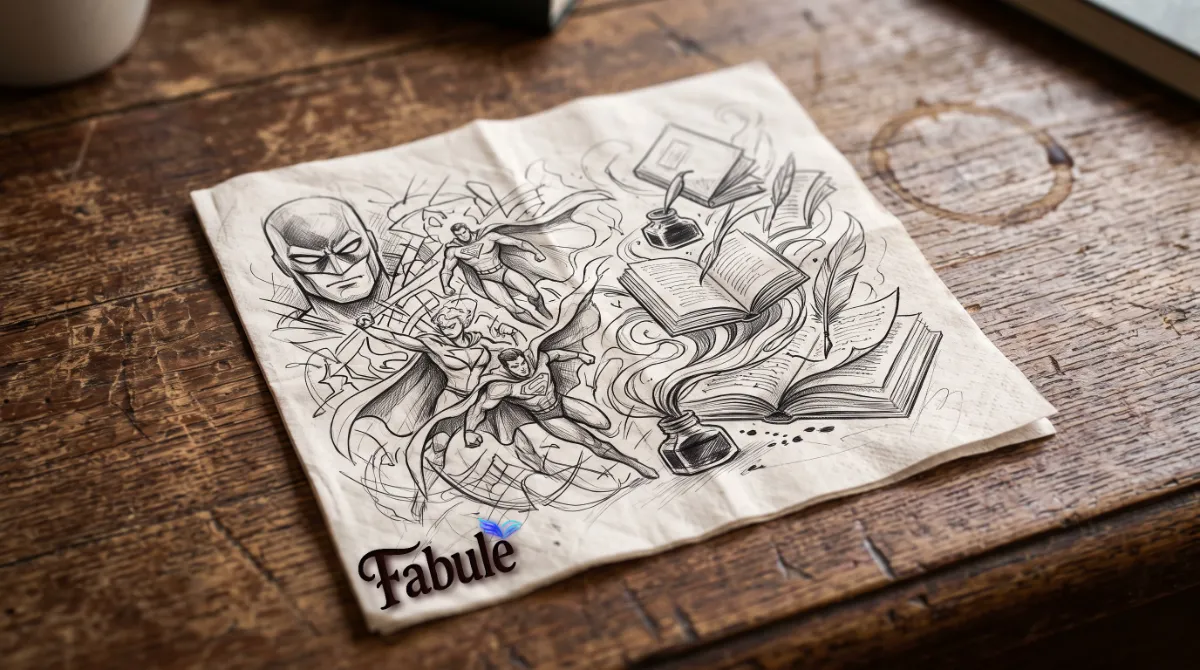
Why Superheroes and Novels Are a Complicated Match
Updated on
Whether it’s an alien in red and blue spandex, a teenager bitten by a radioactive spider, a billionaire inspired by a bat, a scientist bombarded by gamma rays, or teenagers born with a genetic mutation, we have all fallen — and continue to fall — under the spell of superheroes.
Walk into any comic book shop and you’ll find shelves packed with titles dedicated to these characters—you are spoiled for choice. Not to mention their invasion of other media, from blockbusters and animated series to TV shows and video games. Yet, if we try to find a prose novel featuring these same characters, we will find almost none. Why is that?
This is a question many people ask. How is it that characters who have shaped the collective imagination of generations, influenced pop art and media, and conquered the box office, can't find a home on the pages of a novel?
The answer exists, but it’s rather complex.

A Structural Incompatibility
First, we need to look at the nature of the medium itself: the superhero genre is a narrative ecosystem that finds its natural habitat in comic books. This is because the superhero is, first and foremost, a visual icon.
Think of any character: even before their story, psychology, and personality (which are essential elements of a novel), comics grab us with archetypal visual elements—the costume, the posture, the silhouette. This goes beyond the hero itself to every single panel on the page, which can instantly communicate highly symbolic elements like atmosphere, action, and emotion. In short, the superhero is a visual semiotic before it is a narrative one.
The instant communication of the comic book medium is lost in a novel. Everything captured in a single glance in a drawn panel has to be translated into text, draining it of its evocative power.
This structural friction becomes even more obvious when describing action. Every page layout in a comic is a carefully choreographed composition that fuses the core elements of visual storytelling:
- movement;
- speed;
- impact;
- visual composition.
A single splash page communicates in an instant a dynamic sequence that would otherwise require pages of descriptive text in a book.
Infinite Seriality: Why Comics Can Run Forever (and Novels Can't)
Another defining feature of comics that is nearly impossible to replicate in prose is open-ended seriality—virtually infinite continuity. Some comic book writers have spent years, even decades, building story arcs for specific characters. This open-ended nature allows creators to deploy storytelling devices such as:
- retcons (retroactively changing past events or inserting new elements into the past);
- crossovers (bringing different series and characters together, weaving plots across multiple titles);
- reboots (starting a series or character from scratch, often to modernize an otherwise outdated hero);
- parallel universes (placing familiar characters in entirely different settings, like Elseworlds, What If?, Absolute, or Ultimate series).
These elements are incredibly difficult to adapt to a novel, a medium that naturally moves toward a defined narrative arc with a clear resolution. While book series and multi-volume sagas are common—especially in fantasy—the author still structures the narrative with an end in sight. Prose literature simply does not support the infinite continuity—often called permanent narrative stasis—that defines superhero comics. The repetitive loops of the superhero genre, which can go on indefinitely in comics, would quickly feel redundant in prose, making the reader aware of the formula and leading to an inevitable drop in engagement.
The Exception: The Introspective Superhero
Does this mean the symbolic figure of the superhero is doomed to fail in prose? Not necessarily. In some cases, it has actually worked remarkably well.
Superheroes succeed in prose when they break away from the classic tropes of the genre—when the hero is deconstructed, psychoanalyzed, and viewed through an introspective lens. These stories focus on moral ambiguity, internal conflict, and the character’s psychological transformation. Essentially, they succeed when the focus shifts from action-heavy adventures to the character's cultural, philosophical, and allegorical significance, drawing on satire, social science fiction, and contemporary mythology.
A few examples?
- Vicious by V. E. Schwab;
- Soon I Will Be Invincible by Austin Grossman;
- The Amazing Adventures of Kavalier & Clay by Michael Chabon.
Narrative Transportation and the Superhero Reader
Much like novels—and perhaps even more so—superhero comics are subject to the cognitive mechanics of narrative transportation, while also suffering from the pitfalls of fragmented reading.
How often do you find yourself waiting for the next issue, only to realize you've forgotten key plot points, events, or secondary characters? This is even more common with massive, multi-series crossovers that stretch on for months (or years) across several titles.
Losing the thread of a story is just as common in superhero comics as it is in complex novels. That is why we believe a tool like Fabulè could be incredibly valuable for fans of spandex and capes. We have been thinking about this for a while, and we might just have something cooking for the future. As lovers of books and comics, what do you think? Drop us a line at team@fabutatabula.com—we'd love to hear your thoughts, and we might have some exciting news for you soon!
Why don't superheroes work in prose novels?
Because of the inherent nature of the medium. Superhero comics rely on an immediate visual language and open-ended seriality—two features that are incredibly difficult to translate into a traditional novel.
Why are comics a better medium for superheroes than novels?
Comics are the natural home of superheroes because they combine text and imagery, instantly conveying costumes, movement, expression, and action. A single comic panel can deliver in seconds what would take pages of description in a novel.
What is the difference between storytelling in comics and novels?
It lies in how the story is told. Comics use images, panel layouts, and visual pacing to quickly communicate emotion and action. Novels, on the other hand, build immersion through description, dialogue, and deep introspection. Comics prioritize immediate visual impact, while novels delve deeper into psychology, character development, and reflection.
Why are superhero storylines often so long?
Major superhero sagas are built on open-ended seriality. This allows characters to embark on new adventures for decades without a final ending, using narrative tools like crossovers, reboots, retcons, and alternate universes.
What is open-ended seriality in comic books?
Open-ended seriality is a narrative structure where a story has no definitive end, allowing it to continue indefinitely. This lets different writers reimagine the same characters over the decades, creating new storylines without breaking the continuity of the overall universe.
Are there any superhero novels that actually work?
Yes, specifically those that take an introspective approach, exploring the hero's cultural, psychological, and philosophical meaning.
Does the science of narrative transportation apply to comics?
Yes, just as much as it does to novels—perhaps even more so, given that long-running serials and monthly release schedules can lead to fragmented and interrupted reading experiences.
Why is it hard to remember every superhero storyline?
Superhero stories often span dozens of series, massive crossovers, major events, and story arcs published over many years. Breaks between reading, combined with the sheer number of characters and connections, can make it difficult to keep track of key events, relationships, and details.
Can Fabulè be used for comics?
With the right adjustments—focusing on visual cues rather than text—yes. Although Fabulè was designed to assist prose readers, the same principles of narrative transportation and helping readers pick up where they left off apply to comics. In the future, a dedicated version of Fabulè could become a valuable companion for comic book fans, helping them navigate complex plots, character webs, and vast universes without losing the joy of discovery.
Try Fabulè to find the thread of your readings
Start for free