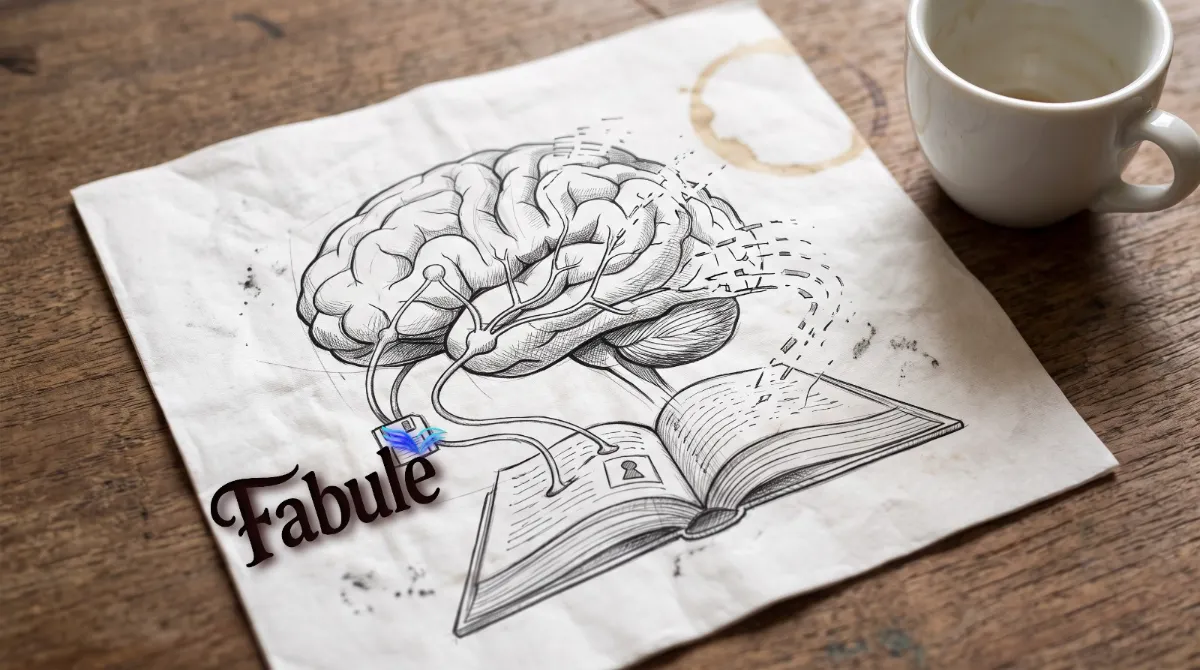
Why Do We Forget What We Read? The Science of Memory
It’s a scenario familiar to any book lover, user of Fabulè, or anyone who reads intermittently: we read a few chapters of a novel, put it down, and perhaps don’t pick it up again for several days. When we finally do, we realize we’ve forgotten entire plot points, a specific sequence of events, how certain characters are related, or even a simple name. This can be deeply frustrating, and it’s a major reason why people abandon books halfway through.
But why does this happen? Let’s clear one thing up right away: this is not a personal failing or a sign of a bad memory. It is a completely natural byproduct of how the human brain and our basic cognitive processes function.

Not Just One Cause, but Four!
How exactly does our cognitive architecture work, and why does the brain forget? The answer doesn't lie in a single flaw, but in four distinct phenomena that interact to shape our mnemonic processes:
The Forgetting Curve: This theory originated in 1885 with the experiments of German psychologist Hermann Ebbinghaus, who memorized lists of nonsense syllables and measured how many he could recall at various time intervals (minutes, hours, days). His findings are highly revealing: Ebbinghaus discovered that memory decay occurs rapidly and drastically within the first 24 hours, before gradually leveling off. This suggests that the crucial factor is not how much we forget, but when. This principle applies not only to disconnected syllables but also to meaningful texts like novels, as memory decline follows the exact same pattern. The key difference is that a novel, unlike a random string of syllables, possesses meaning, structure, and emotional resonance—all of which help jog the memory;
How the Brain Remembers: Theorized by American psychologists Brainerd and Reyna, the fuzzy-trace theory shows that memory doesn't work like a computer hard drive saving intact files. Instead, it functions more like an incredibly efficient and optimized compression system. According to their theory, the brain processes two types of memory: verbatim memory, which captures surface details like exact phrasing and specific names; and gist memory, which retains the core meaning—the “essence” of the narrative, concept, or argument. Verbatim memory decays quickly, while gist memory lingers, continuing to shape our thoughts. In practice, once we process information, our brains discard the superficial elements and hold onto the deeper meaning. This is why we can perfectly recall the core events or the emotions a book evoked long after we've forgotten the finer plot points—especially when prompted by a related trigger, such as a quote, a story dealing with similar themes, or a conversation on the subject.
Mind-Wandering: While reading, our brain often activates what is known as the default mode network—the neural network associated with self-referential thought, daydreaming, and planning. This happens when we disconnect from the page in front of us and start thinking about something else. Our eyes scan the lines, but the words never reach our long-term memory because they were never properly encoded. This explains an experience every reader knows all too well: reaching the bottom of a page only to realize you have absolutely no idea what you just read. It isn’t a failure of comprehension or memory; the information was simply never registered in the first place;
The Impact of the Medium: Research on the screen inferiority effect suggests that reading on digital devices tends to result in shallower comprehension compared to reading on paper, particularly with information-dense texts or under time constraints. When reading a physical book, the brain unconsciously maps a “geography” of the text, remembering roughly where certain information was located on the page. This physical layout acts as a mental anchor. On a screen, where text continuously scrolls, this spatial anchor is lost.
What Helps Your Memory (and What Doesn't)
Once we understand how memory processes work and how information is acquired, we can distinguish between what actually aids memory recall and what is merely a myth:
Talking about the book is an excellent strategy: Discussing a book, explaining the plot, or writing a review in your own words forces you to actively process the material. The more connections you forge between the text and how you explain it, the more mental retrieval hooks you create;
Active retrieval (or retrieval practice): This is a highly effective cognitive technique that strengthens memory by forcing your brain to retrieve information rather than simply re-reading it. At the end of a reading session, close the book and ask yourself a few summary questions (What just happened? Which characters appeared? How are they connected? What challenges or conflicts did they face?). This active search process solidifies the newly acquired information in your mind;
Time is an ally: Though counterintuitive, mentally returning to a book days or weeks later—such as by asking yourself a quick question about the plot—strengthens memory far more than binge-reading a whole book in a single sitting or over a couple of days;
Interest fuels retention: Personal motivation and emotional investment heavily influence what we remember. A book that genuinely captivates you triggers far more neural encoding resources than a book read out of sheer obligation;
Sleep on it: Sleep plays a vital role in memory consolidation. It is during sleep that the brain actively stabilizes and integrates the memories and information gathered throughout the day;
Re-reading is less effective than you think: Passively skimming the same pages creates a false sense of familiarity that we mistake for mastery. The same goes for compulsive highlighting; while it may occasionally aid visual memory, it does little to help consolidate or encode the text. Retrieving information from memory without looking at the page (the retrieval practice mentioned in point 2) is far more powerful than endless re-reading.
The Actor’s Secret to Memory
The challenge of memorization—and the dread of blanking on a line—is a classic anxiety for actors, especially early in their careers. By trade, actors are professional readers who must internalize incredibly long and complex texts (and, in classical theater, recite them in verse). The fear of a line slipping away into the recesses of the mind is a terror every young performer knows intimately. But as anyone who has studied acting seriously knows, this obstacle is largely an illusion. Trying to memorize a script like a school child learning a poem by heart is the worst approach. It places immense pressure on the brain, making it far more likely that information will fade during the encoding process (leading to that common frustration: “I just can’t get this line into my head”).
The solution lies in the very same principles of memory we have just discussed, leading to what is known as “organic memory.” This is a deep, natural command of the text built through active recall, mental association, and repetition through performance. Sound familiar? It is a highly practical, active application of retrieval practice combined with the strategy of explaining a text in your own words.
The method is remarkably simple: two actors sit facing each other, maintaining eye contact, with zero distractions.
Selecting a section of the script to learn, they read their lines—whether a monologue or dialogue—while keeping their eyes on one another as much as possible. Once finished, they set the script aside and attempt to repeat what they just read. Naturally, very little will have stuck on the first try, so they rely on improvisation and interpretation, guided by a clear understanding of the text's meaning, subtext, and character objectives (which must be analyzed beforehand).
Once they finish the scene, they immediately pick up the script again—without a break—and re-read the same section, then put it down and repeat it, blending memory and improvisation. Each actor will notice that certain lines and thoughts, especially those tied to specific emotional shifts, begin to take root. They then repeat the process a third time, again without a pause.
Done correctly, this three-step cycle allows an actor to memorize the vast majority of a text without any mental strain or headaches. Not a bad trick, is it?
Asking the Wrong Question
In light of this, asking “Why do we forget what we read?” is actually the wrong question, because the brain does remember—just not in the way we expect. The question assumes that the goal of reading is archiving. But since the brain is not a simple archive, expecting it to act like one is a recipe for frustration. Instead, we should ask: “What do we want to take away from this book, and how can we build lasting connections with it?”
Forgetting what you read is not a failure; it is proof that your brain is doing its job by filtering information. The issue only arises when we don't give our brains the tools to filter correctly, or when the frustration of forgetting leads us to abandon a book entirely.
The Importance of “Dialogue”
It is no coincidence that the most effective memory techniques—active retrieval, elaboration, spaced repetition, and emotional engagement—all take the form of a conversation with the text. A book read in passive silence, never questioned, debated, or linked to other ideas, will inevitably fade into a vague gist, leaving the rest to be forgotten. Conversely, engaging in a dialogue with a book prompts the mind to connect, retrieve, and reformulate, consolidating the material into memory.
As we often say, this is exactly what Fabulè is designed for: to let you converse with your books, ask questions, explore reflections, and clarify points. By doing so, you don’t just keep track of the plot; key events, characters, and details become etched in your mind through a thoughtful, reasoned interaction with the text, guided by your AI companion. That way, when you recommend that life-changing book to your friends, you can describe the plot in vivid detail. Just remember: no spoilers!
Is it normal to forget the plot of a book?
Yes, over time, it is entirely normal to remember only the general essence of a story and lose track of details like names, minor characters, or specific scenes. The practical problem arises when you pick a book back up after a break and find you no longer have enough context to continue reading easily.
Why does the brain forget what we read?
This is caused by four interacting phenomena: rapid memory decay within the first 24 hours (the forgetting curve), the brain’s tendency to compress information (fuzzy-trace theory)—which prioritizes gist over verbatim details—mind-wandering during reading (the default mode network), and the drop in comprehension quality when reading on screens versus paper (the screen inferiority effect).
Why do we forget the details of a book but remember the overall plot?
Because memory does not store all information equally. Specific details like names, quotes, and minor events fade quickly, whereas the general meaning and core “essence” of the narrative linger. This principle is explained by fuzzy-trace theory, which distinguishes between verbatim and gist information.
What is the difference between verbatim and gist information?
Verbatim information consists of precise details, such as exact words, names, and minor events, which are forgotten quickly. Gist information is the condensed version containing the core concepts, themes, and meaning of the text (the “essence” of the story).
What are the best techniques for remembering what we read?
Talking about the book with someone, trying to recall or mentally summarize what you just read (retrieval practice), asking yourself questions about the book after some time has passed, staying actively engaged and interested in the text, and getting quality sleep to consolidate what you have learned.
What is a common myth about remembering what we read?
Rereading repeatedly or passively highlighting text. These techniques merely create an illusion of competence without actually helping consolidate information in long-term memory.
How do actors tackle the challenge of memorization?
Through a process known as organic memory. Rather than rote learning, they consolidate the text naturally through continuous active reading and improvisation with a scene partner, creating an ongoing dialogue around the material they need to learn.
Why is asking why we forget what we read the wrong question?
Because it is a poorly framed question. The brain does remember, just not in the way we expect. The brain is not a simple archive; it actively filters information. Forgetting parts of what we read means our brain is filtering efficiently. Instead, we should guide the brain to select the right details to avoid the frustration that leads to abandoning books.
How can we better remember what we read?
By actively engaging with the book: retrieving information from memory, asking questions about the plot, rephrasing what we read, and making connections between characters, events, and concepts. Fabulè applies this exact principle, allowing readers to converse with their books and retrieve the context they need to keep reading.
References
Try Fabulè to find the thread of your readings
Start for free